
Have you ever wondered how nature keeps everything in balance? Every leaf, drop of rain, and even the smallest grain of soil is part of a much larger story—the story of ecosystems. These aren’t just chunks of land or patches of forest; they are alive with energy flow, nutrient cycles, and living communities that sustain life as we know it. From plants capturing sunlight to fungi breaking down dead trees, ecosystems are filled with invisible yet powerful processes that hold life together.
In this blog, we’ll explore the hidden workings of ecosystems, including energy flow, nutrient cycling (think carbon, nitrogen, and phosphorus cycles), and processes like primary production and decomposition. And, we'll get up close with India’s diverse ecosystems, including its forests, grasslands, rivers, and coasts.
Breaking Down Ecosystem Structure – Nature’s Living Network
Imagine walking through a forest. It’s a vast, layered world, full of life from ground to treetop. This layered setup is what ecologists call ecosystem structure. It includes two major players: the biotic (living) and abiotic (non-living) components that are essential for the life of the ecosystem. Let’s dive into these pieces.
Biotic Components: The Cast of Characters
In every ecosystem, there’s a fascinating cast of living things that interact in unique ways:
- Producers (Autotrophs): These are the solar-powered plants, algae, and some bacteria. They’re the foundation, converting sunlight into energy through photosynthesis.
- Consumers (Heterotrophs): Animals, from ants to elephants, need these producers or other animals to survive.
- Decomposers (Detritivores): Fungi, bacteria, and creatures like earthworms break down dead material, turning it back into soil nutrients.
Abiotic Components: Nature’s Framework
Now, what about the non-living parts? Abiotic components—like sunlight, water, soil, and air—are the stage on which all these living actors perform. They don’t just sit in the background; they directly impact how plants grow, where animals live, and how nutrients move through the system.
Ecosystem Function – The Pulse that Keeps Everything Alive
Ecosystem functions are like a heartbeat for each ecosystem, responsible for maintaining life. Think of these as essential processes—like energy flow and nutrient cycling—that keep ecosystems running smoothly.
Energy Flow: Powering Life’s Chain Reaction
It all begins with the sun. Sunlight is captured by photosynthesizing organisms, setting off a chain of energy transfers:
- Primary Producers capture sunlight and convert it to energy.
- Primary Consumers (like herbivores) eat plants and gain energy.
- Secondary and Tertiary Consumers (carnivores) eat herbivores, moving energy up the food chain.
- Decomposers recycle leftover energy from waste and dead organisms.
But here’s the catch—energy flow is one-way. With every transfer, some energy is lost as heat, which limits how far energy can go up the food chain and keeps the ecosystem balanced.
Nutrient Cycles – The Recycling Program of Ecosystems
Unlike energy, nutrients like carbon, nitrogen, and phosphorus are cyclical; they move through an endless loop that supports life at every level.
The Carbon Cycle: The Backbone of Life
Carbon is in everything alive and in the air. Through photosynthesis, plants absorb CO₂, which moves through the food chain and is then released back into the air through respiration or decomposition.
 |
| Attribution: Diagram adapted from U.S. DOE, Biological and Environmental Research Information System., Public domain, via Wikimedia Commons |
 |
| Attribution-NASA, Public domain, via Wikimedia Commons |
The Nitrogen Cycle: Fuel for Growth
Even though nitrogen is abundant in the air, it’s not directly usable by most plants. Certain bacteria convert it to a form plants can use, driving the nitrogen cycle. This transformation is essential for creating DNA and proteins in every living cell.
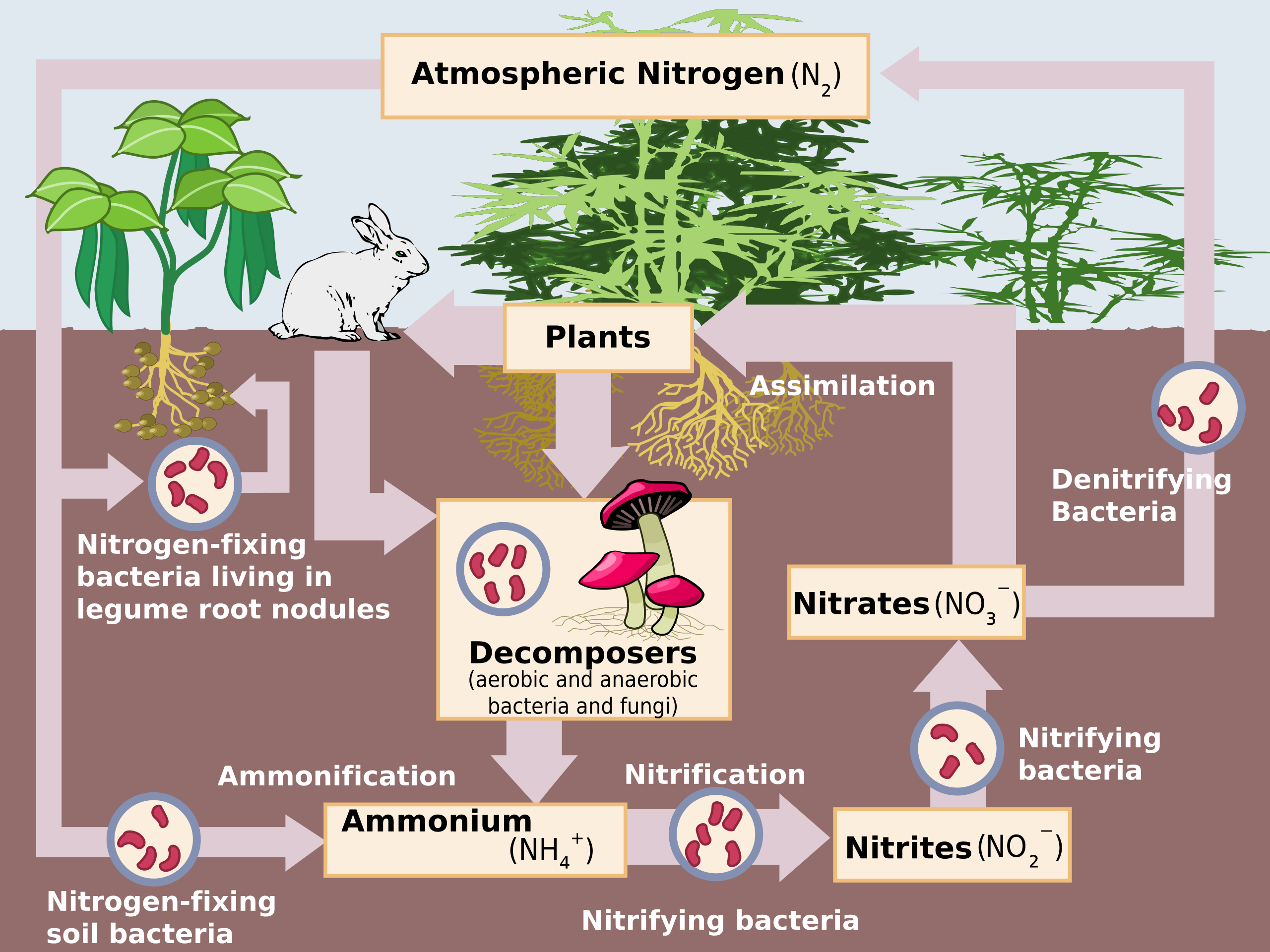 |
| Attribution: Cicle_del_nitrogen_de.svg: *Cicle_del_nitrogen_ca.svg: Johann Dréo (User:Nojhan), traduction de Joanjoc d'après Image:Cycle azote fr.svg.derivative work: Burkhard (talk)Nitrogen_Cycle.jpg: Environmental Protection Agencyderivative work: Raeky, CC BY-SA 3.0 <https://creativecommons.org/licenses/by-sa/3.0>, via Wikimedia Commons |
The Phosphorus Cycle: Limited but Crucial
Phosphorus is different because it doesn’t cycle through the atmosphere. It comes from rocks and is carried by water into the soil, helping plants grow. But phosphorus runoff can disrupt ecosystems, leading to problems like algal blooms.
 |
| Attribution: Welcome1To1The1Jungle at English Wikipedia, CC BY 3.0 <https://creativecommons.org/licenses/by/3.0>, via Wikimedia Commons |
Primary Production and Decomposition – Creating and Recycling Life’s Resources
How does life start and end in an ecosystem? That’s where primary production and decomposition come in.
Primary Production: Nature’s Energy Output
Primary production is the rate at which plants and other producers convert sunlight into usable energy. It sets the energy budget for the entire ecosystem. Factors like sunlight, water availability, and temperature all affect how productive an ecosystem can be.
Decomposition: Nature’s Recycling System
While primary production builds the ecosystem’s energy, decomposition takes care of waste. Through decomposers like fungi and bacteria, organic matter is broken down, and nutrients are released back into the soil to be reused. Moisture and temperature play huge roles here; decomposition speeds up in warm, wet climates.
A Closer Look at Indian Ecosystems – A Land of Diversity
India’s ecosystems are remarkably diverse, from the towering forests of the Himalayas to the rich coral reefs along the coastline. Each ecosystem has its unique structure and function, creating a tapestry of life across the subcontinent.
Terrestrial Ecosystems
Forest Ecosystems: Breathing Life into the Land
India’s forests range from lush tropical rainforests to coniferous forests in the Himalayas. They’re not just beautiful; they help regulate the climate and store carbon, making them critical for maintaining life balance.
- Biodiversity Hotspots: India’s forests house everything from Bengal tigers to unique plant species, showcasing high levels of biodiversity. This richness supports complex food webs and plays a key role in nutrient cycling.
Grassland Ecosystems: Open Spaces with Unique Life
Grasslands in India vary, from the alpine meadows in the Himalayas to tropical savannas in the central plateau. They may look bare, but these ecosystems support grazing animals and ground-nesting birds. Monsoon rains play a key role here, dictating the availability of water and the timing of growth.
Aquatic Ecosystems
Freshwater Ecosystems: Rivers, Lakes, and Wetlands
India’s rivers and wetlands are vital for human life, offering drinking water, agriculture, and biodiversity. They are critical for nutrient cycling, as they transport nutrients, sediments, and even life across vast distances.
- Diverse Species: Rivers like the Ganges and Brahmaputra teem with fish, birds, and other life. Wetlands are havens for migratory birds and amphibians, forming unique ecosystems within themselves.
Marine and Estuarine Ecosystems: Coastal Lifelines
Marine life along India’s coastline is incredibly diverse, from the corals around the Andaman Islands to the dense mangrove forests of the Sundarbans. These ecosystems play a big role in carbon storage, climate regulation, and fisheries support.
- Estuaries: Where rivers meet the sea, estuaries are nutrient-rich zones that support fish, shellfish, and plants, acting as nurseries for marine species.
Conservation in India – Protecting What’s Precious
India’s ecosystems are under increasing pressure from urbanization, climate change, and pollution. The good news is that conservation efforts are underway.
- Protected Areas: With numerous national parks and sanctuaries, India protects areas like Ranthambhore and Kaziranga, which house tigers, elephants, and other endangered species.
- Local Involvement: Many communities are actively involved in sustainable practices, from ecotourism to forest management.
- Global Efforts: As a member of various environmental agreements, India collaborates globally to combat climate change and biodiversity loss.
Conclusion: The Ecosystem’s Story Is Our Story
Ecosystem ecology reveals how closely connected we are to the world around us. Every element—from carbon molecules to a grazing antelope—has a role to play. India’s ecosystems, with their diversity and complexity, showcase the interconnectedness of life and highlight the importance of every link in the chain. By understanding these systems, we are better equipped to protect and sustain the world that sustains us.