The incredible journey of life kicks off with the intricate processes of gametogenesis, fertilization, and early development, which serve as the building blocks for the emergence of complex organisms. Every step, from the creation of gametes to the development of embryos and seeds, is marked by precise molecular and cellular events that guide the transformation from a single fertilized cell to a multifaceted organism. In this comprehensive educational piece, we explore the captivating realm of gametogenesis, fertilization, and early development, unveiling the mechanisms that drive sperm-egg recognition, embryo sac development, zygote formation, cleavage, gastrulation, establishment of embryonic fields, and seed formation.
Gametogenesis:
Spermatogenesis
During spermatogenesis, spermatogonia, which are the precursor cells, undergo a series of mitotic divisions and differentiation in the testes to ultimately generate mature spermatozoa.
 |
| Attribution: OpenStax College, CC BY 3.0 <https://creativecommons.org/licenses/by/3.0>, via Wikimedia Commons |
Oogenesis
The process of oogenesis is the transformation of oogonia, which are cells produced in the ovaries, into mature ova or eggs through a series of meiotic divisions and the maturation of the cytoplasm.

|
| Attribution: Acedatrey2, CC BY-SA 4.0 <https://creativecommons.org/licenses/by-sa/4.0>, via Wikimedia Commons |
 |
| Author: Sciencia58, CC0, via Wikimedia Commons |
Fertilization and Sperm-Egg Recognition
Sperm-Egg Recognition
During fertilization, sperm cells undergo a process called capacitation, where they become capable of penetrating the protective layers surrounding the egg. This process is facilitated by specific cell surface molecules and receptors present in both the sperm and egg, as well as acrosome reactions.
 |
| Attribution: Atdoan0, CC BY-SA 4.0 <https://creativecommons.org/licenses/by-sa/4.0>, via Wikimedia Commons |
The egg's surrounding zona pellucida holds glycoproteins that help sperm attach to and merge with the egg during fertilization.
 |
| Author: LadyofHats, Public domain, via Wikimedia Commons |
Early Development in Animals
Zygote Formation
When the sperm fertilizes the egg, it forms a new cell called a zygote that has a full set of chromosomes. This marks the beginning of the development of an embryo.
 |
| Author:{{Sciencia58}}, CC0, via Wikimedia Commons |
Cleavage
After fertilization, the zygote undergoes rapid cell divisions, a process known as cleavage, resulting in the formation of a multicellular embryo called a morula.
 |
| Fig.-spiral cleavage in gastropod Trochus Morgan Q. Goulding, CC BY 2.5 <https://creativecommons.org/licenses/by/2.5>, via Wikimedia Commons |
 |
Fig- First stages of division of mammalian embryo. Semidiagrammatic. (From a drawing by Allen Thomson.) z.p. Zona striata. p.gl. Polar bodies. a. Two-cell stage. b. Four-cell stage. c. Eight-cell stage. d, e. Morula stage
Attribution: Henry Vandyke Carter (1831–1897) |
Blastula Formation
As cells continue to divide, they eventually form a blastula, which is defined by the presence of a fluid-filled cavity known as the blastocoel.
Gastrulation and Germ Layer Formation
Gastrulation
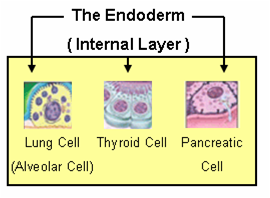
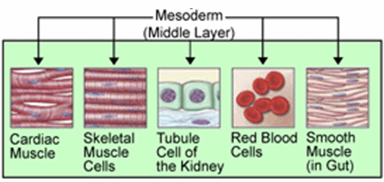
During gastrulation, which is a key stage of embryonic development, cells undergo intricate movements and rearrangements to give rise to the three primary germ layers: the ectoderm, mesoderm, and endoderm.
 |
Fig.- This diagram shows the difference between the two major types of coelomates: the protostomes (molluscs, annelids, arthropods, ...) and deuterostomes (echinoderms, vertebrates, ...). These groups differ in several characteristics of early development; In deuterostomes, blastula divisions is called "radial cleavage" because it occur parallel or perpendicular to the major polar axis. In protostomes, the cleavage is called "spiral" because division planes are oriented obliquely to the polar major axis. During gastrulation, the protostomes embryos' mouth was given first by the blastopore while the anus was formed later and vice versa for the deuterostomes.
Attribution: WYassineMrabet✉, CC BY-SA 3.0 <https://creativecommons.org/licenses/by-sa/3.0>, via Wikimedia Commons |
 |
| Author: Abigail Pyne, Public domain, via Wikimedia Commons |
Establishment of Embryonic Fields
During embryonic development, signalling molecules and transcription factors work together to create specific areas within the embryo, each with its own unique potential for development.
 |
| Author: en:User:J.Steinbock, Public domain, via Wikimedia Commons |
 |
| Attribution: J.Steinbock, Public domain, via Wikimedia Commons |
Early Development in Plants
Embryo Sac Development
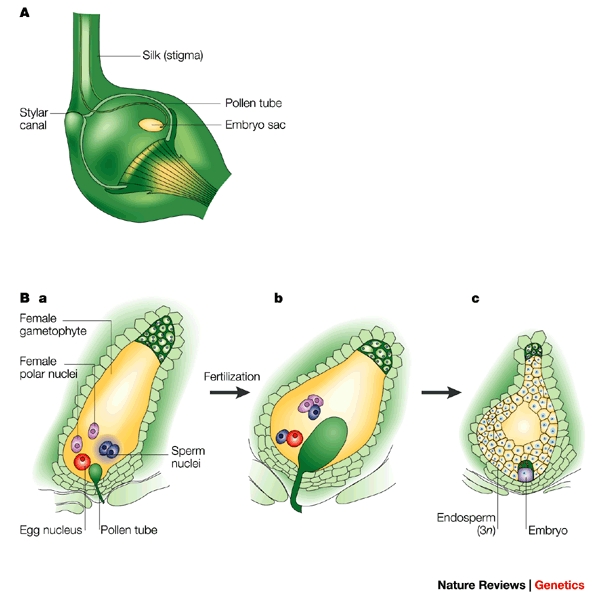
The female reproductive structure of a plant, known as the ovule, is where the female gametophyte undergoes a series of developmental stages. This culminates in the formation of an embryo sac, which houses the important egg cell along with other accessory cells. |
| Author: Qef and Fulvio314, Public domain, via Wikimedia Commons |
Double Fertilization
During double fertilization in plants, one sperm cell combines with the egg to form the zygote, which eventually develops into the plant embryo. Simultaneously, another sperm cell fuses with the central cell to create the endosperm, which provides essential nutrients to support the growth and development of the embryo.
 |
| Attribution: nn, CC BY 4.0 <https://creativecommons.org/licenses/by/4.0>, via Wikimedia Commons |
 |
| Attribution: The original uploader was Triploid at English Wikipedia., CC BY 3.0 <https://creativecommons.org/licenses/by/3.0>, via Wikimedia Commons |
Establishment of Symmetry and Seed Formation
Establishment of Symmetry
Plant embryos create balance by carrying out uneven cell divisions and directional growth, which results in the development of specific embryonic axes.
Seed Formation and Germination
After fertilization, the zygote grows into an embryo inside the seed. The embryo remains dormant until favourable conditions prompt germination, leading to the establishment of a seedling. |
| Author: LadyofHats, Public domain, via Wikimedia Commons |
Conclusion
Gametogenesis, fertilization, and early development are the crucial early phases in the creation of life, influencing the path of an organism's growth. These stages involve complex processes such as the production of gametes and the formation of embryonic axes and seeds, all of which are regulated by a multitude of molecular and cellular interactions. Through the exploration of the underlying mechanisms of these processes, scientists can gain valuable insights into the fundamental principles of biology. This knowledge can also lead to the identification of potential therapeutic interventions and innovative agricultural improvements. As we delve deeper into the enigmatic beginnings of life, we enhance our comprehension of the intricate developmental processes that have contributed to the rich diversity of life on our planet.


