
The process of morphogenesis in plants encompasses the intricate development of the plant's overall form and internal structure. Concurrently, organogenesis pertains to the specific formation of individual organs within the plant. These processes are finely regulated and encompass multifaceted genetic, molecular, and environmental interactions.
Organization of Shoot and Root Apical Meristem
Shoot Apical Meristem (SAM)
The Shoot Apical Meristem (SAM) is a critical region found at the tips of plant shoots. It contains actively dividing cells and plays a vital role in producing new plant organs, including leaves, flowers, and stems.
 |
| Attribution: Daniel,levine at English Wikipedia, CC BY-SA 3.0 <https://creativecommons.org/licenses/by-sa/3.0>, via Wikimedia Commons |
Structure: The shoot apical meristem (SAM) comprises a central zone (CZ) where cells divide slowly and a peripheral zone (PZ) where cells divide rapidly. Below these zones, the rib meristem contributes to the formation of stem tissue.
 |
| Fig.- Organisation of an apical meristem (growing tip) Central zone Peripheral zone Medullary (i.e. central) meristem Medullary tissue Attribution: Attribution: Dakada. '''Licence''': {{GFDL}} lincensed under Creative Commons Attribution-Share Alike 3.0 Unported license. |
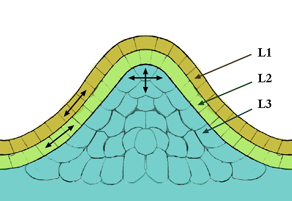 |
| Fig.-Tunica-corpus model of the apical meristem (growing tip). The epidermal (L1) and subepidermal (L2) layers form the outer layers called the tunica. The inner L3 layer is called the corpus. Cells in the L1 and L2 layers divide in a sideways fashion, which keeps these layers distinct, whereas the L3 layer divides more randomly. Attribution: Dakada. '''Licence''': {{GFDL}} lincensed under Creative Commons Attribution-Share Alike 3.0 Unported license. |
Root Apical Meristem (RAM)
The Root Apical Meristem (RAM) is located at the tips of roots and is responsible for root growth.
Structure: The RAM (root apical meristem) is composed of a quiescent center (QC) at its core, which is surrounded by actively dividing cells. The quiescent center plays a key role in maintaining the population of stem cells in the meristematic region that surrounds it. |
Fig- Root tip magnified 100× under an optical microscope.
|
Shoot and Root Development
Shoot Development
Shoot development involves the formation and differentiation of various structures like stems, leaves, and flowers from the SAM.
Stem Development: The stem is formed through the elongation of cells generated by the shoot apical meristem (SAM). As the stem develops, the vascular tissues, xylem, and phloem undergo differentiation to provide structural support and enable the transport of water, nutrients, and other substances throughout the plant. |
| Fig.- Shoot development in dicot stem Attribution: FWren, CC BY-SA 4.0 <https://creativecommons.org/licenses/by-sa/4.0>, via Wikimedia Commons |
Leaf Initiation: Leaf primordia begin to form at the sides of the shoot apical meristem (SAM) i.e. at the flanks of SAM following a precise pattern, under the influence of hormonal signals such as auxin.
 |
| Fig.- : Photomicrograph of a Coleus stem tip. A=Procambium, B=Ground meristem, C=Leaf gap, D=Trichome, E=Apical meristem, F=Developing leaf primordia, G=Leaf Primordium, H=Axillary bud, I=Developing vascular tissue. Scale=0.2mm Attribution: Jon Houseman, CC BY-SA 4.0 <https://creativecommons.org/licenses/by-sa/4.0>, via Wikimedia Commons |
Root Development
Root development is a complex process involving cell division, elongation, and differentiation originating from the RAM.
Primary Root Growth: The primary root grows by meristematic cell division followed by cell elongation in the elongation zone..jpg) |
| Fig- Gymnosperm stem lateral shoot development in five-year Pinus |
Leaf Development and Phyllotaxy
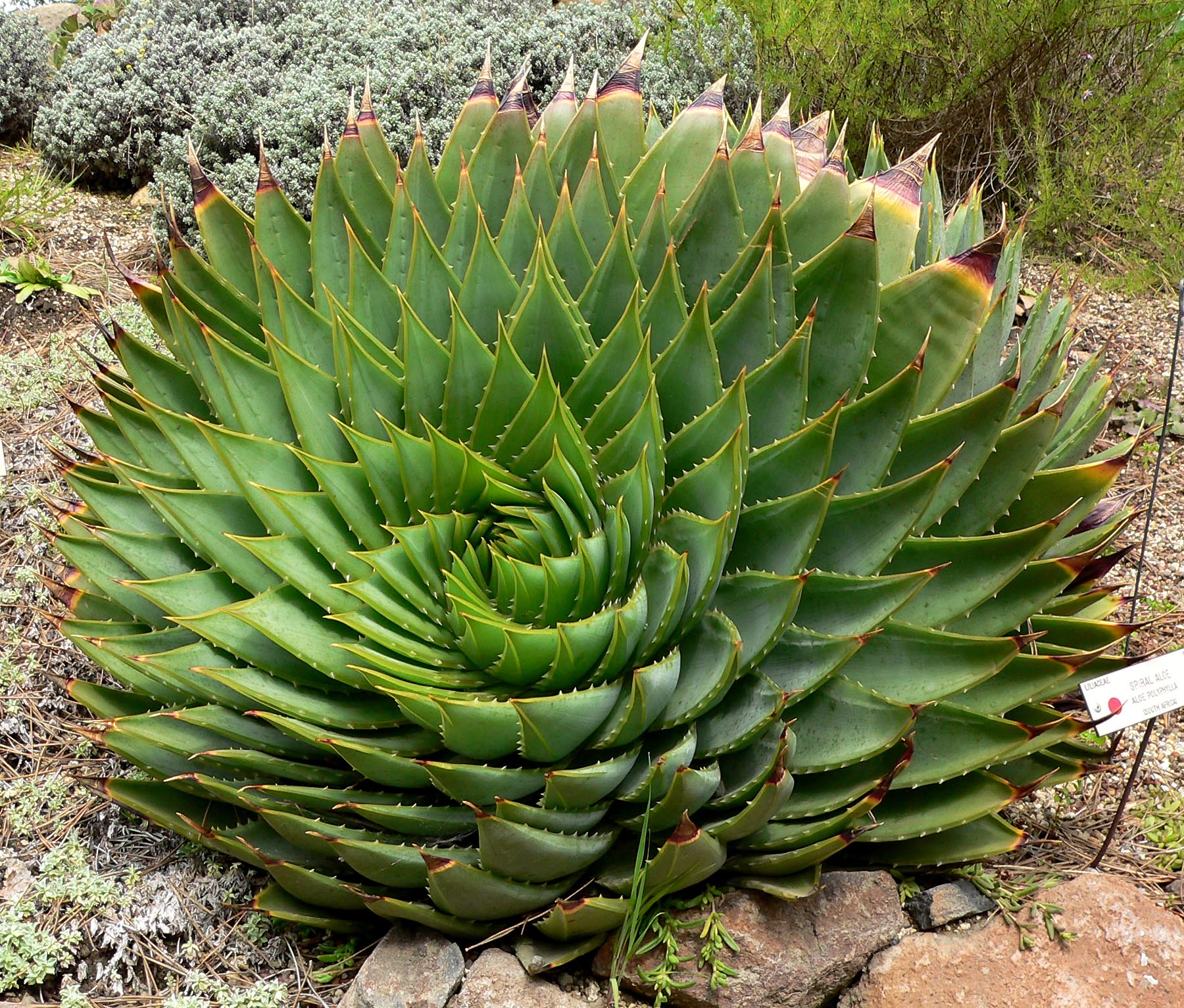
Leaf development and phyllotaxy (the arrangement of leaves on the stem) are critical for optimizing light capture and photosynthesis.
Leaf Primordia Formation: Auxin maxima at the shoot apical meristem (SAM) triggers the initiation of leaf primordia formation. |
| Attribution: Yuliya Krasylenko, CC BY 4.0 <https://creativecommons.org/licenses/by/4.0>, via Wikimedia Commons |
 |
| Fig: Phyllotaxis. Legend: a. alternate, b. opposite - decussate (rotation 90°) c. opposite - distichous (not rotated), d. whorled. Attribution: Agnieszka Kwiecień (Nova), CC BY 3.0 <https://creativecommons.org/licenses/by/3.0>, via Wikimedia Commons |
 |
| Attribution: L. Shyamal, CC BY-SA 2.5 <https://creativecommons.org/licenses/by-sa/2.5>, via Wikimedia Commons |
 |
| Attribution: Stan Shebs, CC BY-SA 3.0 <https://creativecommons.org/licenses/by-sa/3.0>, via Wikimedia Commons |
 |
| Attribution: Cmglee, CC BY-SA 4.0 <https://creativecommons.org/licenses/by-sa/4.0>, via Wikimedia Commons |
Transition to Flowering
The transition to flowering involves the conversion of the SAM from a vegetative to a reproductive state, leading to the formation of flowers.
Floral Meristems
Floral meristems are specialized structures that give rise to flowers.
Induction of Floral Meristems: The transition is controlled by environmental cues (e.g., light and temperature) and internal signals (e.g., hormones). Key genes involved include LEAFY (LFY) and APETALA1 (AP1). |
| Author: LadyofHats, Public domain, via Wikimedia Commons |
Floral Development in Arabidopsis
Arabidopsis thaliana, a model organism, has provided significant insights into floral development.
- ABC Model: The ABC model describes the functions of three gene classes (A, B, and C) in determining floral organ identity.
- Class A genes: AP1 and APETALA2 (AP2) specify sepals.
- Class A and B genes: AP3 and PISTILLATA (PI) specify petals.
- Class B and C genes: AGAMOUS (AG) specify stamens.
- Class C genes alone specify carpels.
 |
| Attribution: Ian Alexander, CC BY-SA 4.0 <https://creativecommons.org/licenses/by-sa/4.0>, via Wikimedia Commons |
Floral Development in Antirrhinum
Antirrhinum majus (snapdragon) is another important model for studying floral development.
Similarity to Arabidopsis: The ABC model, which describes the genetic regulation of floral organ identity in plants, exhibits some variations. Notably, in this context, DEFICIENS (DEF) and GLOBOSA (GLO) are considered equivalent to AP3 and PI in Arabidopsis, a flowering plant widely used as a model organism in plant biology.Organ Identity Genes: Mutations occurring in these genes can lead to significant alterations in the development of various body parts i.e. homeotic transformations, providing valuable insights into the genetic control of flower development.
Conclusion
The growth and formation of organs in plants involve a complex interplay of genetic, molecular, and environmental factors. Studying these processes in model plants like Arabidopsis and Antirrhinum helps us gain valuable insights into plant development, with potential applications in agriculture and horticulture. By understanding the mechanisms governing shoot and root development, leaf formation, phyllotaxy, and floral transition, scientists can enhance crop yield, improve resistance to environmental stresses, and promote overall plant health. This knowledge is essential for the advancement of plant biology and biotechnology.