
In the complex world of plant biology, solute transport, and photoassimilate translocation are too important to be disregarded. Starting from water and nutrient uptake from the soil up to the process of sugar transportation occurring via photosynthesis, plants employ several mechanisms to secure survival and growth. In this blog, let's delve into the exciting process of solute transport and photoassimilate translocation.
Uptake of Water, Ions, and Solute from Soil:
Plants uptake water and other required nutrients by the root system very effectively. This is done predominantly through two mechanisms: passive transport and active transport.
Passive transport in osmosis and diffusion involves molecular movements of water and solute molecules through the solution in a low to high concentration gradient.
Active transport, on the other hand, is an energy-requiring system that moves ions and other molecules within a cellular solution against their concentration gradient with transport proteins found in the root cell membrane.
Transport Across Membranes Within the root, water, and solutes have to permeate several cell layers to gain access to vascular tissues where they can use the bulk flow to be transported long distances. This occurs through two pathways, and they are referred to as the symplastic and apoplastic pathways.
In the symplastic path, the water and solutes flow from cell to cell through the interconnected protoplasts of plant cells by plasmodesmata, and in the apoplastic pathway, they move along the cell wall and intercellular spaces without passing through the protoplast.
 |
| Attribution- Jackacon, vectorised by Smartse, Public domain, via Wikimedia Commons |
Transport in Xylem and Phloem:
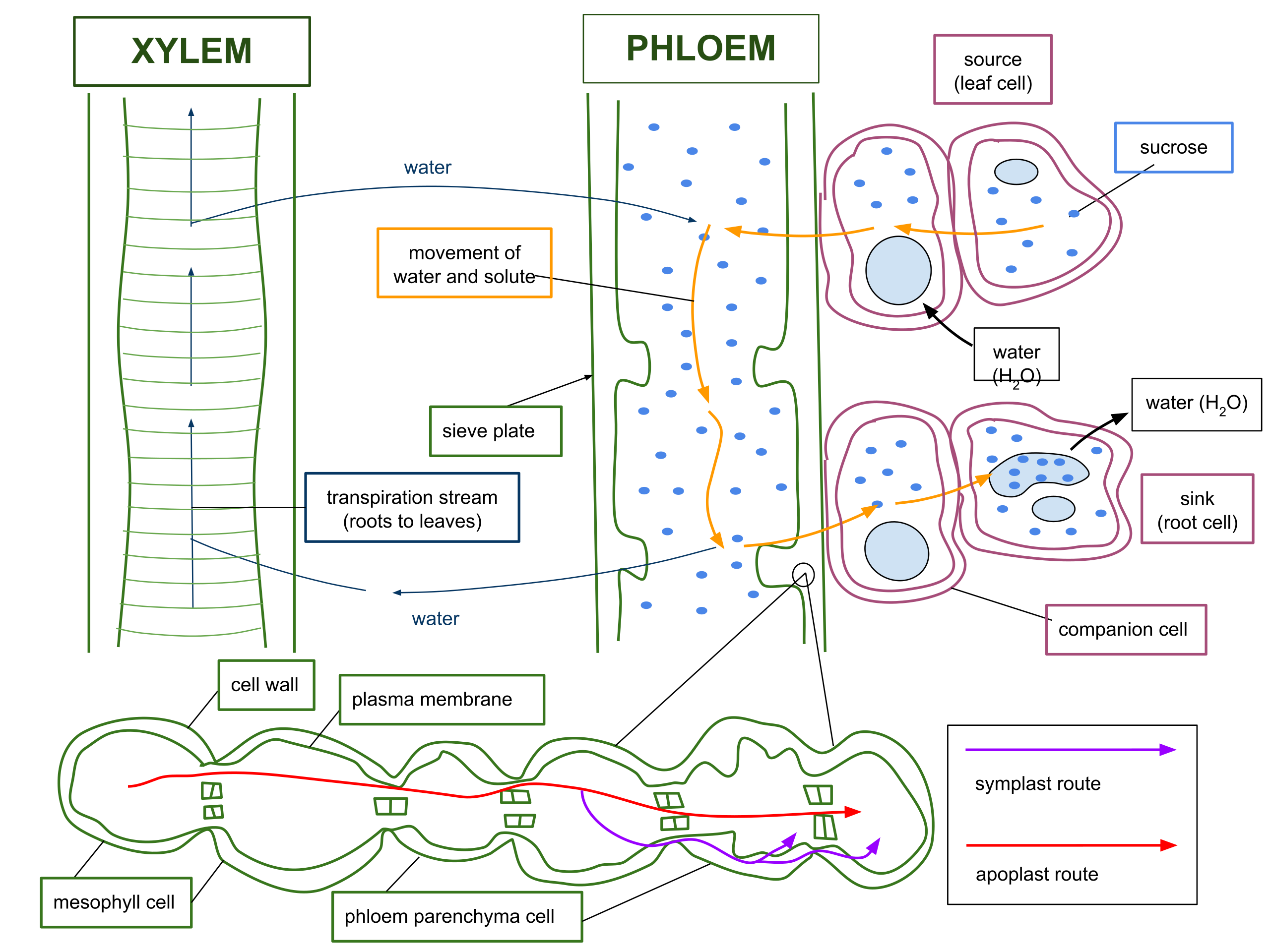
The Xylem and phloem are the vascular tissues responsible for an upward movement of water, minerals, and photoassimilates (sugars) within the plant. Water and minerals ascend from the roots to the shoots due to transpiration and root pressure. This sets up an adverse pressure gradient that sucks the water up. Conversely, phloem transports manufactured sugar and other organic nutrients produced in the leaves to areas the plants need for development or respiration.
 |
| Attribution: Kl3580, CC BY-SA 4.0 <https://creativecommons.org/licenses/by-sa/4.0>, via Wikimedia Commons |
Transpiration:
It is the process by which water from the plant's aerial tissues evaporates majorly via stomata, minute openings on the leave's surface. Thus, this water loss from the spaces of the stomata generates an adverse pressure gradient in the xylem, which further results in conditions where water travels upward from the roots to the shoot. The transpiration plays a role in controlling the temperature of the plant. And also, the dissolved minerals are brought about from the root.
 |
| Attribution: FeltyRacketeer6, CC BY-SA 4.0 <https://creativecommons.org/licenses/by-sa/4.0>, via Wikimedia Commons |
 |
| Attribution: Laurel Jules, CC BY-SA 3.0 <https://creativecommons.org/licenses/by-sa/3.0>, via Wikimedia Commons |
Mechanisms of Loading and Unloading of Photoassimilates:
Inside the leaves, the products of photosynthesis are sugars and amino acids. The transfer of the sugars and amino acids to other parts of the plant for growth, storage, and metabolism, therefore, has to be done. Photoassimilates are transported into the phloem in source tissues—at their point of manufacture, usually mature leaves— by active transport mechanisms. Upon loading into the transport cells, these are transported through the phloem sieve tubes to sink tissues like growing regions, roots, and fruits, where, in turn, they are unloaded and utilized.
 |
| Attribution: Miairo, CC BY-SA 4.0 <https://creativecommons.org/licenses/by-sa/4.0>, via Wikimedia Commons |
Conclusion:
The plant relies on the solute transport and movement of photoassimilates for productivity growth and survival. The description of how the above processes take place would not only help one define plant physiology but also help open avenues for agriculture purposes, mainly in using the nutrients to maximum efficiency, leading to an increase in harvests. The more we reveal the secrets of plant biology, the greater our respect for the adaptability and efficiency of plants in using resources from their environment.