
Respiration is an absolute necessity of life for any organism because that is the process through which the exchange of gases is made possible to allow cellular metabolism to happen. This is, however, not a universal process, as the mechanisms and structures involved in respiration vary highly from one species to another. This blog will elaborate on the specifics of the respiratory system through comparisons of respiration between other species, anatomical considerations, transport and exchange of gases, elimination of waste, and regulation of respiration.
1. Comparison of Respiration in Other Species:
Mammals: In mammals, the primary mode of respiration occurs in the lungs, which are very sophisticated organs adapted for gas exchange. During inhalation, the air is taken in through the nostrils, flows down the trachea, into the bronchi, and finally into the alveoli, where oxygen and carbon dioxide exchange with blood.
Birds: Birds have a very peculiar respiratory system that has two parts: the lungs, as is the case with humans, and air sacs These allow a constant flow of air in and out of the lungs to enhance the exchange of gases. Air moves through the trachea, then into the posterior air sacs, the lungs, and finally out through the anterior air sacs.
Fish: Fish extract dissolved oxygen from water with the help of gills. Water containing oxygen enters the mouth, and flows over the gill filaments, where oxygen moves across the filaments and is extracted, and then out through the gill slits. Given the low oxygen concentration in water, this process is very effective.
Insects: Insects have a tracheal system for respiration. Air enters via spiracles, openings on the body surface, and is carried throughout the body by a network of tracheae before directly contacting tissues. This obviates the need for a circulatory system to carry gases to the different parts of the body.
.gif) |
| Attribution: Cadeyrnia, CC BY-SA 4.0 <https://creativecommons.org/licenses/by-sa/4.0>, via Wikimedia Commons |
2. Anatomical Considerations:
Mammals: Lungs are spongy organs that are rich in alveoli, which provide a large surface area for gas exchange.
 |
| Attribution- LadyofHats, Public domain, via Wikimedia Commons |
Birds: Air sacs and para bronchi lead to a unidirectional airflow into the lungs.
Attribution- Dr. Jacquie Jacob, University of Kentucky, CC0, via Wikimedia Commons

 |
Author:commons: Shazz pl. wiki: Shazz Air sacs 1 humerus bone 2 sub clavicular sac 3 trachea 4 thoracic sacs 5 abdominal sacs 6 lungs |
 |
| Attribution: Cruithne9, CC BY-SA 4.0 <https://creativecommons.org/licenses/by-sa/4.0>, via Wikimedia Commons |
Fish: Gas exchange occurs over the large surface area within the gills, which are made up of many filaments and lamellae.
 |
| Attribution: Користувач:Shao / Anaxibia, CC BY-SA 3.0 <https://creativecommons.org/licenses/by-sa/3.0>, via Wikimedia Commons |
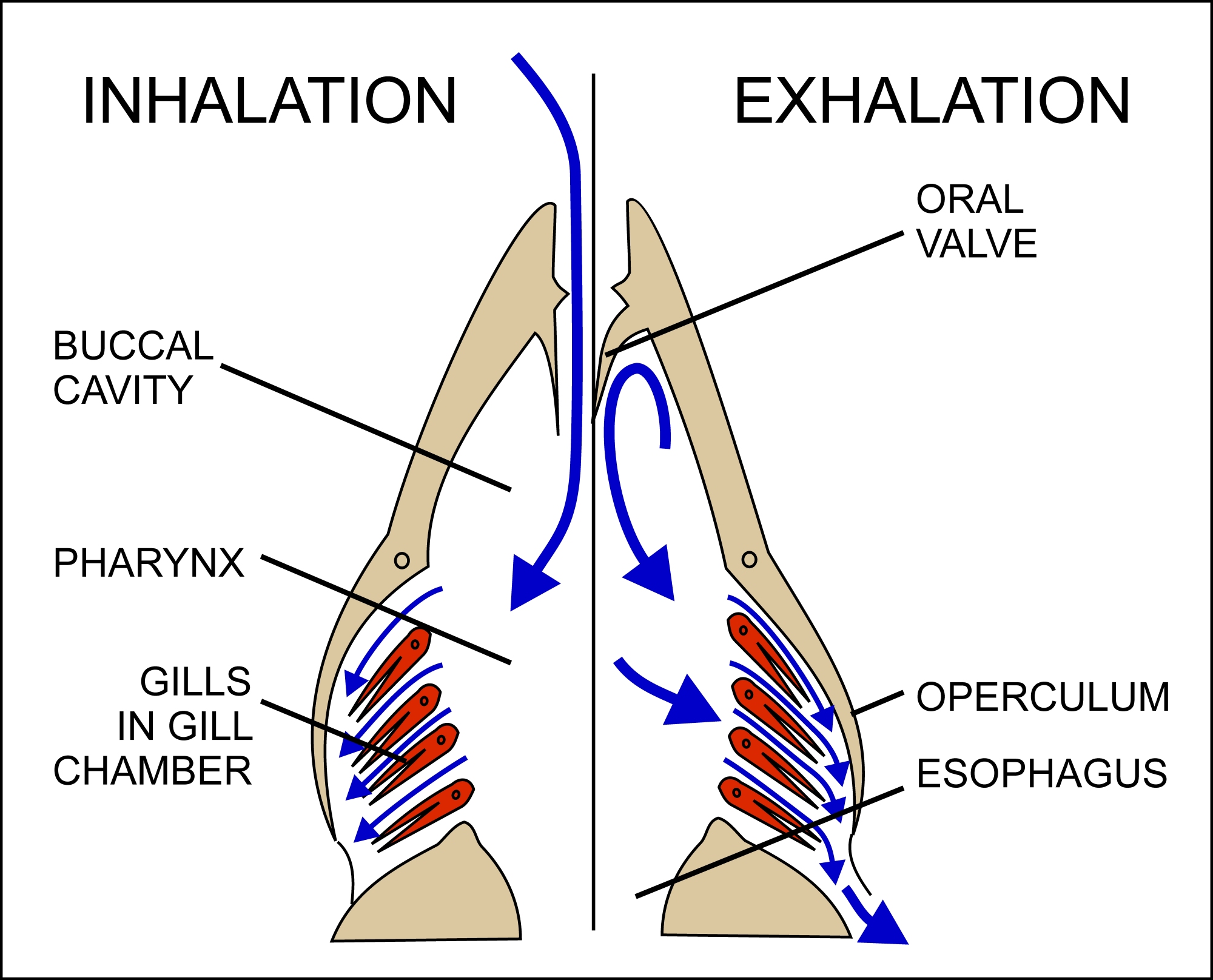 |
| Attribution: Cruithne9, CC BY-SA 4.0 <https://creativecommons.org/licenses/by-sa/4.0>, via Wikimedia Commons |
Insects: There is a network of tubes where oxygen from the tracheal system is supplied directly to the tissues.
 |
| Attribution: M. Readey, CC BY-SA 3.0 <https://creativecommons.org/licenses/by-sa/3.0>, via Wikimedia Commons |
3. Transport of Gases The transport of gases occurs by several mechanisms:
Oxygen Transport: In mammals, oxygen is carried mainly by haemoglobin in red blood cells. In fish, too, it is haemoglobin carrying the oxygen, but it derives it from water. In insects, however, there is a direct delivery of oxygen to the tissues by the tracheal system.
Transport of Carbon Dioxide: CO2 is transported back to the lungs in three ways: plasma CO2, bicarbonate ion, or carbaminohemoglobin. This happens in relatively the same way in most animal species that possess a circulatory-based blood system.
4. Gases Exchange There is but a simple mechanism for gases diffusing, which involves diffusion as influenced by partial pressure gradients:
Mammals: oxygen diffuses from alveoli into blood, whereas carbon dioxide diffuses from blood into alveoli.
Birds: Unidirectional flow of air through the lungs allows always a high concentration gradient so effective gas exchange can occur;
Fish: Countercurrent exchange across the gills maximizes diffusion of oxygen into the blood as water and blood flow across the gills in opposite directions.
Insects: Diffusion directly from the tracheae to the tissues maximizes the efficiency of the exchange very quickly.
5. Waste Elimination During respiration, there is also an excretion of metabolic wastes:
CO2 Excretion: Carbon dioxide is released when one exhales. In mammals and birds, it is excreted via the exhalation process. In fish, carbon dioxide diffuses out across the gill membranes.
Other Excretions Insects eliminate gases directly through spiracles. They also excrete ammonia and other wastes through different organs, either kidneys in more advanced insects or by using nephridia in primitive insects.
6. Neural and Chemical Regulation of Respiration Respiration is regulated through the neural and chemical methods for ensuring homeostasis:
Neural Regulation: In mammals, the medulla oblongata and pons present in the brainstem regulate the breathing rhythm and depth.
Avian Respiratory Control: Birds have the exact basic mechanisms for controlling respiration that all other vertebrates do so that their air sacs are appropriately ventilated. For example, the chemoreceptors of the blood vessels monitor the CO2, O2, and pH of the bird. Increased concentrations of CO2 or lowered pH (acidic conditions) trigger a faster breathing rate to remove the excess CO2 in the body. This is a classic feedback mechanism necessary to maintain proper gas levels in the body.
Conclusions
The respiratory systems of various species are beautifully adapted to their environment and lifestyle. From the sophisticated lung structures of mammals to the efficient gill systems of fish and the unique tracheal networks of insects, each system exemplifies nature's ingenious evolutionary process in maintaining life through adequate respiration. Thereby, the realization of all these diverse mechanisms not only illustrates biological complexity but also focuses on the link in all life forms on Earth.