
Imagine being able to travel back in time to witness the very beginnings of life on Earth. What would you see? Life, as we know it, didn’t just appear overnight—it took billions of years, countless events, and huge changes in climate and landscapes. Paleontology is the science that helps us peer into that ancient world, one fossil at a time. With each discovery, we get a little closer to understanding how life transformed from tiny unicellular organisms to plants, animals, and eventually, humans.
In this post, let’s explore Earth’s evolutionary time scale—the eras, periods, and epochs that mark major changes in life on our planet. From the first microbes to the rise of primates and modern Homo sapiens, the history of life is one of resilience, adaptation, and sheer tenacity.
The Evolutionary Time Scale – Our Map Through Time
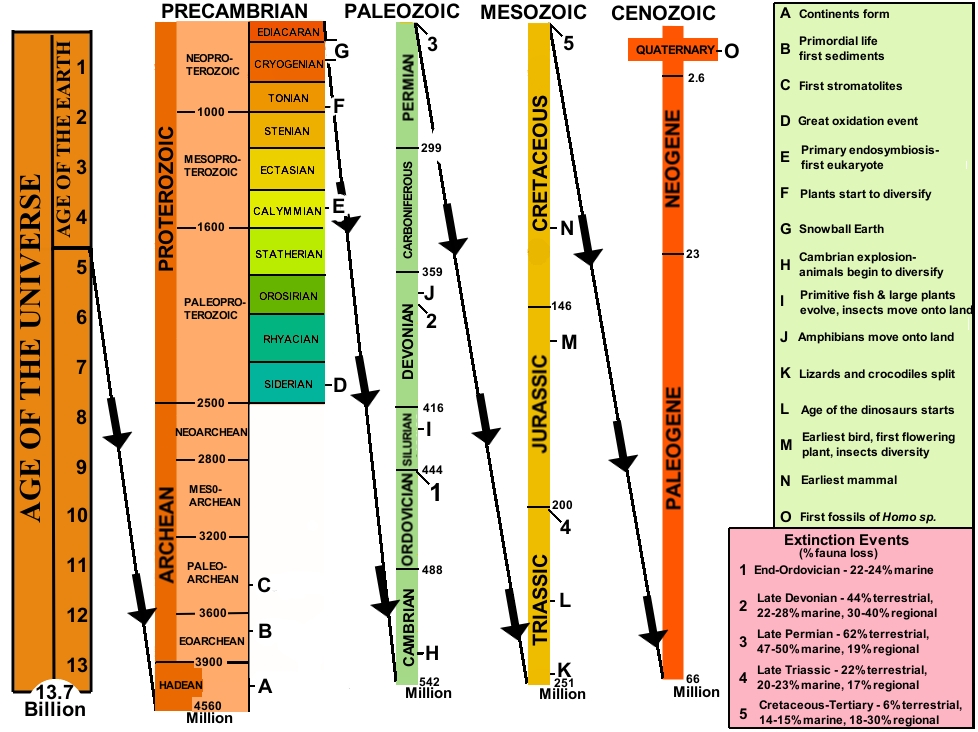
The vast history of life on Earth is organized by paleontologists into a timeline known as the evolutionary time scale. This scale divides Earth’s 4.6 billion-year history into eras, periods, and epochs. Each of these sections represents a chapter in the story of life on Earth, marking major shifts in climate, geology, and biology.
Eras – The Major Chapters of Earth’s History
The evolutionary time scale’s broadest divisions are eras, each covering hundreds of millions of years and marking significant changes in Earth’s environment. Here are the four main eras:
- Precambrian (4.6 billion to 541 million years ago): Where life began with simple, single-celled organisms.
- Paleozoic (541 to 252 million years ago): The age of marine life, plants, and the first animals to crawl onto land.
- Mesozoic (252 to 66 million years ago): The era when dinosaurs ruled, mammals and birds emerged, and plants diversified.
- Cenozoic (66 million years ago to today): The age of mammals, culminating in the evolution of humans.
Periods and Epochs – Fine-Tuning the Time Scale
Within each era, we have periods and epochs, which are shorter spans that capture the smaller but significant changes in Earth’s story. For example, in the Cenozoic Era, there’s the Pleistocene Epoch—a time of major ice ages and the evolution of the earliest humans.
 |
| Attribution: Montage by Sciencia58 based on works by Richie Diesterheft, JJ Harrison (jjharrison89@facebook.com), Ghedoghedo, Fritz Geller-Grimm and others., CC BY-SA 4.0 <https://creativecommons.org/licenses/by-sa/4.0>, via Wikimedia Commons |
Major Events in Earth’s Evolutionary Timeline
Across these eras, life on Earth has experienced several transformative events that forever changed the trajectory of evolution. Let’s look at some of the biggest milestones in this long, complex history.
The Birth of Earth and Origin of Life (4.6 Billion – 3.5 Billion Years Ago)
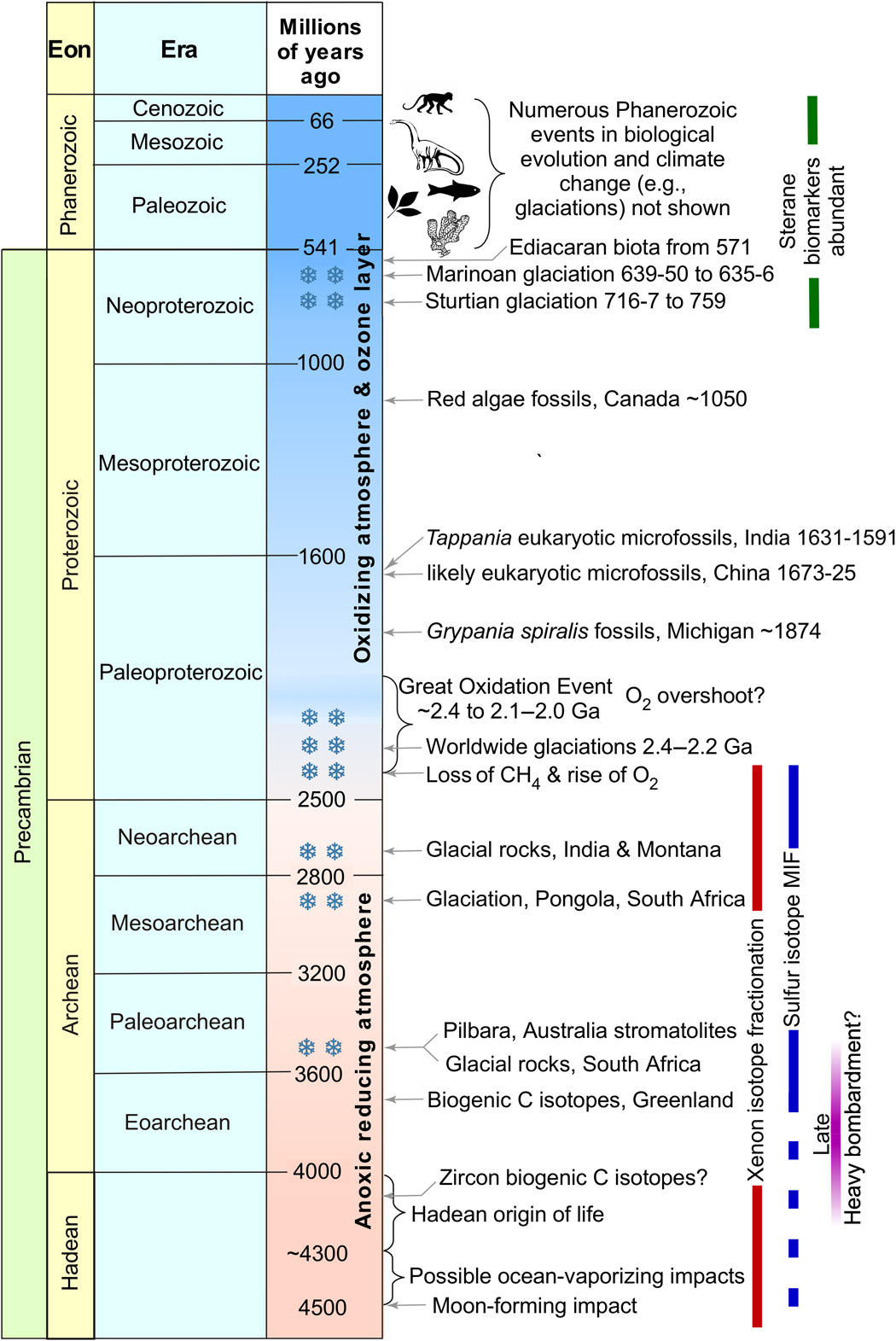
Earth was formed about 4.6 billion years ago, and it wasn’t long (relatively speaking!) before life emerged in the form of single-celled organisms. Unicellular organisms like bacteria appeared around 3.5 billion years ago, probably in ocean environments near hydrothermal vents. This early life thrived without oxygen, evolving ways to survive in the hostile conditions of early Earth.
The Great Oxidation Event (2.4 Billion Years Ago)
Some of the first single-celled organisms, known as cyanobacteria, figured out how to make their own food through photosynthesis. As a byproduct, they released oxygen, which gradually transformed Earth’s atmosphere in what’s called the Great Oxidation Event. This was a huge moment in history, as oxygen allowed for more complex forms of life to eventually evolve.
The First Complex Cells and Multicellular Life (2 Billion – 600 Million Years Ago)
With oxygen filling the atmosphere, life took another leap forward. Simple cells evolved into eukaryotic cells—cells with a nucleus and other specialized structures. These complex cells could eventually form multicellular organisms, setting the stage for the diversity of life forms that would later emerge.
Interesting Note: Multicellular life likely started as colonies of cells working together, which allowed for the evolution of larger, more complex organisms.
 |
| Attribution: David C. Catling and Kevin J. Zahnle, CC BY-SA 4.0 <https://creativecommons.org/licenses/by-sa/4.0>, via Wikimedia Commons |
The Paleozoic Era – Life Moves from Oceans to Land
The Paleozoic Era is a time of incredible evolution, from the explosion of marine life to the movement of plants and animals onto land.
The Cambrian Explosion (541 Million Years Ago)
One of the most exciting times in evolutionary history is the Cambrian Explosion, which happened around 541 million years ago. Life diversified at an incredible rate, with most major animal groups appearing in the fossil record, including early forms of fish, arthropods, and mollusks.
The Great Migration to Land
By the late Paleozoic, both plants and animals had started to colonize land. Plants were the first to make this move, evolving structures to survive outside water. Then came animals, including early amphibians who could live both on land and in water. This move set the stage for new ecosystems and food chains that would become crucial to future evolution.
Fun Fact: The first amphibians had limbs adapted for walking on land, although they still depended on water for laying eggs.
The Permian Extinction (252 Million Years Ago)
The Paleozoic Era ended with a massive event known as the Permian Extinction, which wiped out nearly 90% of Earth’s species. This catastrophe cleared the way for new life forms, including the dinosaurs that would soon dominate the Mesozoic Era.
The Mesozoic Era – Dinosaurs and the Rise of Birds and Mammals
The Mesozoic Era is often called the Age of Dinosaurs. But it’s also when we see the appearance of birds, mammals, and flowering plants that would change Earth’s landscapes.
The Reign of Dinosaurs
Dinosaurs first appeared in the Triassic Period and went on to rule land, sea, and air. By the Jurassic Period, these creatures had adapted to every environment imaginable, from tiny, feathered hunters to massive herbivores like the Brachiosaurus. Dinosaurs were truly Earth’s rulers, evolving into some of the most iconic creatures in history.
Did You Know? The largest dinosaurs, like Argentinosaurus, weighed as much as 10 elephants!
The Rise of Flowering Plants
During the Cretaceous Period, flowering plants began to spread, bringing new colors, smells, and forms to Earth’s ecosystems. They attracted insects and created a new food source for herbivores. This change helped create a complex web of life that we still see today.
The K-T Extinction (66 Million Years Ago)
The Mesozoic Era ended with the K-T Extinction, triggered by an asteroid impact and possibly volcanic activity. This extinction wiped out the dinosaurs and allowed mammals to step into the spotlight, leading to a new era of evolution.
The Cenozoic Era – Mammals Thrive and Primates Evolve
The Cenozoic Era saw mammals evolve and diversify, filling niches left empty by the dinosaurs. It’s also the time when primates emerged, eventually giving rise to humans.
Mammal Evolution
With dinosaurs gone, mammals adapted to a range of environments. They evolved into species as varied as bats, horses, whales, and eventually primates. Mammals became the dominant animals on land, sea, and air, and this era has been nicknamed the Age of Mammals.
The First Primates
Primates evolved around 65 million years ago. These early creatures had grasping hands, larger brains, and forward-facing eyes—perfect for life in the trees. They developed more complex social behaviors and eventually diversified into different lineages, including monkeys, apes, and finally, humans.
Interesting Insight: Climate and changing environments played a huge role in primate evolution, pushing species to adapt to new conditions and find new ways of life.
Hominin Evolution – The Road to Humans
The first hominins—our direct ancestors—appeared about 7 million years ago in Africa. Over time, these early hominins evolved to walk on two legs and eventually developed larger brains. Around 2.5 million years ago, the genus Homo emerged, including species like Homo habilis, Homo erectus, and ultimately Homo sapiens.
Fun Fact: Homo erectus was among the first hominins to migrate out of Africa, traveling across continents and surviving in diverse environments for nearly 2 million years.
 |
| Attribution: Thompsma, CC BY-SA 3.0 <https://creativecommons.org/licenses/by-sa/3.0>, via Wikimedia Commons |
A Quick Guide to Major Groups of Plants and Animals
Earth’s life forms evolved in response to changing climates and landscapes. Here’s a quick look at some of the major groups that shaped our world:
Plants
- Algae: Earth’s first plants, evolving in the ocean.
- Bryophytes: Early land plants, like mosses, that don’t have roots or vascular systems.
- Ferns and Gymnosperms: These evolved true vascular systems, allowing plants to grow larger.
- Angiosperms (Flowering Plants): Emerged in the Mesozoic, attracting animals with their flowers and fruit.
Animals
- Invertebrates: Dominated the Cambrian seas with creatures like trilobites and early mollusks.
- Fish: The first vertebrates, evolving fins and later moving onto land.
- Amphibians and Reptiles: Evolved in the Paleozoic, with amphibians as the first land vertebrates.
- Birds and Mammals: Evolved in the Mesozoic, diversifying after the dinosaur extinction.
Stages in Primate Evolution Leading to Humans
Our own story in the Tree of Life is one of adaptation, intelligence, and resilience. Here’s a look at the key stages in primate and human evolution:
Early Primates
The first primates, emerging around 65 million years ago, were small, tree-dwelling animals. They had forward-facing eyes, which helped with depth perception, and flexible hands that could grasp branches.
The Rise of Apes
Apes evolved around 25 million years ago, giving rise to larger, more social species. As climates changed, these apes adapted to new environments, from dense forests to open savannas.
The Hominins Emerge
About 7 million years ago, the first hominins, like Australopithecus, emerged in Africa. These early ancestors walked upright, allowing them to move more efficiently on land, and developed tools for survival.
The Rise of Homo sapiens
Finally, Homo sapiens appeared around 300,000 years ago. With large brains, complex language, and strong social networks, they spread across the globe, adapting to various climates and establishing sophisticated societies.
Conclusion: Life’s Remarkable Story
Earth’s evolutionary timeline is a story of adaptation, resilience, and survival against all odds. From the first single-celled life forms to the evolution of humans, each chapter in life’s history reveals something incredible about nature’s power to change and evolve. The study of paleontology continues to unravel this story, helping us appreciate our place in a vast and interconnected history.
This journey through time shows how each species, from the simplest algae to complex humans, is woven into the tapestry of life. We are all connected by the same natural processes that started billions of years ago, reminding us of life’s remarkable journey.